Pearson Accelerator
Reading Diagnostic Assessment
Context
On Pearson’s Accelerator team, which takes AI concepts from problem definition to tested prototypes that shape what the business builds, I designed an AI reading tutor for PTE Academic learners. Pearson is unusual in owning both the world’s English-language textbooks and its tests, and the strategic prize is connecting them: moving from static content toward diagnostic intelligence that follows a learner from classroom to exam.
The user is an adult learner preparing for a high-stakes exam tied to migration, university or work, which puts unusual weight on two things a static test ignores: whether the feedback can be trusted, and how a score makes you feel. This proof of concept explored whether an AI tutor and a cognitive diagnostic could make reading practice genuinely adaptive and explanatory, and whether learners would want it.
Problem
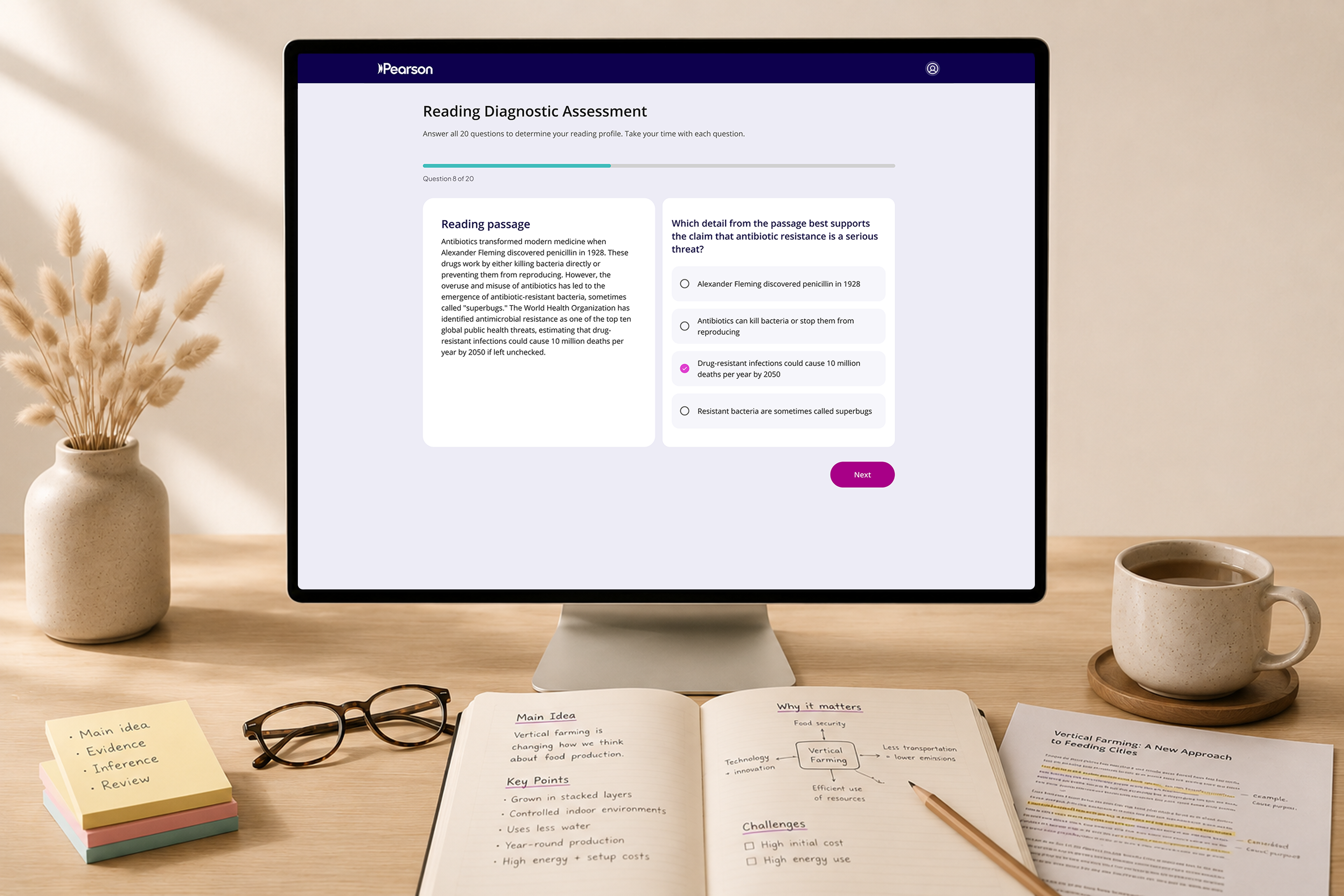
Learners preparing for PTE Academic often don’t know where they stand on reading, or what to practise next, and a wrong answer rarely explains what to do differently.
No clear starting point
No. 01Learners can’t easily gauge their reading level or see a path to test readiness.
Practice without feedback
No. 02Static tests mark answers right or wrong but rarely explain the ‘why’ behind a mistake.
One size fits all
No. 03Generic material doesn’t adapt to the individual, so practice time isn’t spent where it counts.
Process
I mapped how a learner moves from ‘am I ready?’ to ‘what should I practise next?’, to find where reading practice breaks down. The design focused on four main areas:
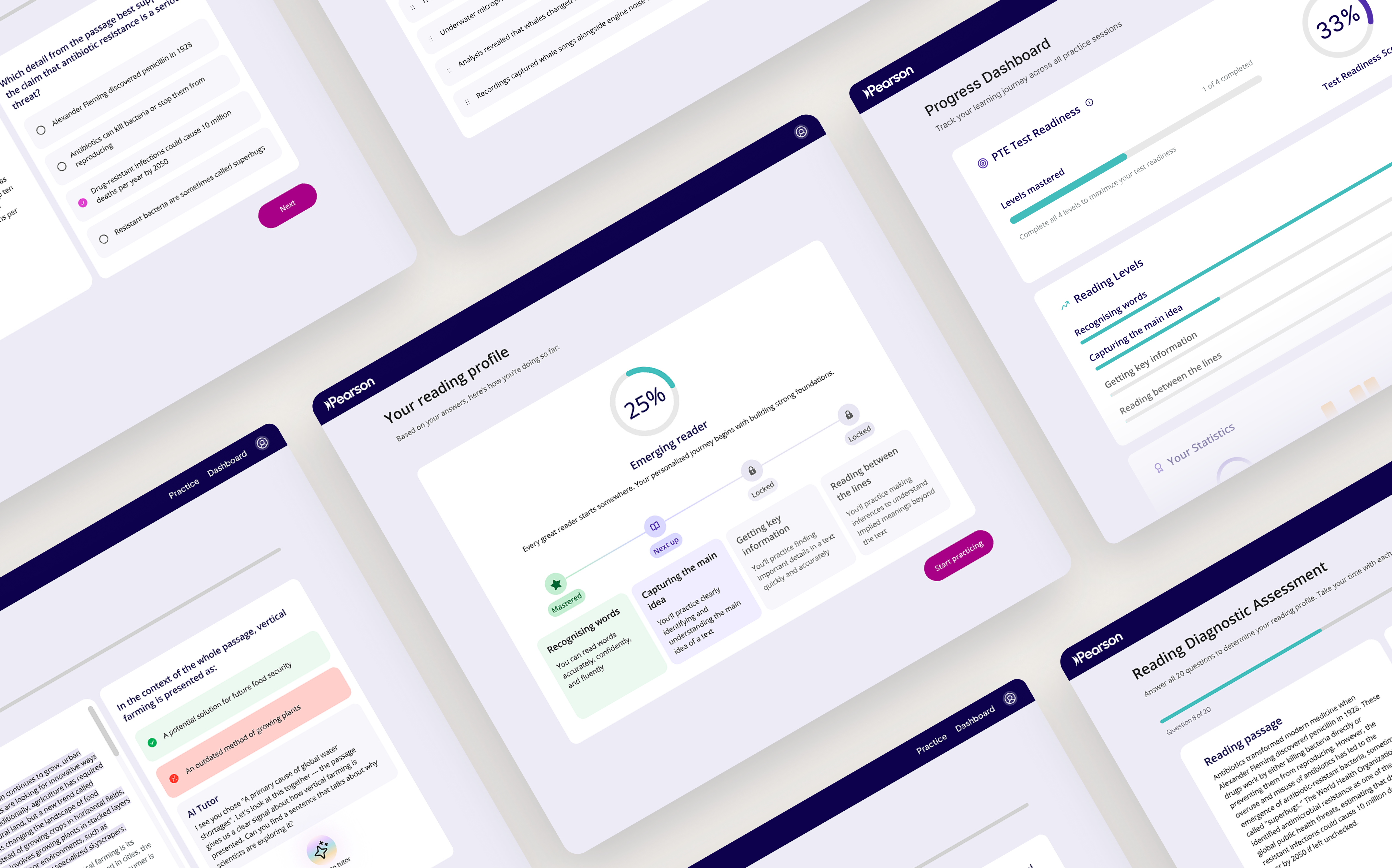
Mastery ladder: an abstract reading level becomes four masterable skills, from Recognising words to Reading between the lines.
Readiness score: a single, legible signal for where a learner stands and how far they have to go.
Adaptive practice: a 20-question diagnostic places the learner, then practice targets their weakest skills, not a generic average.
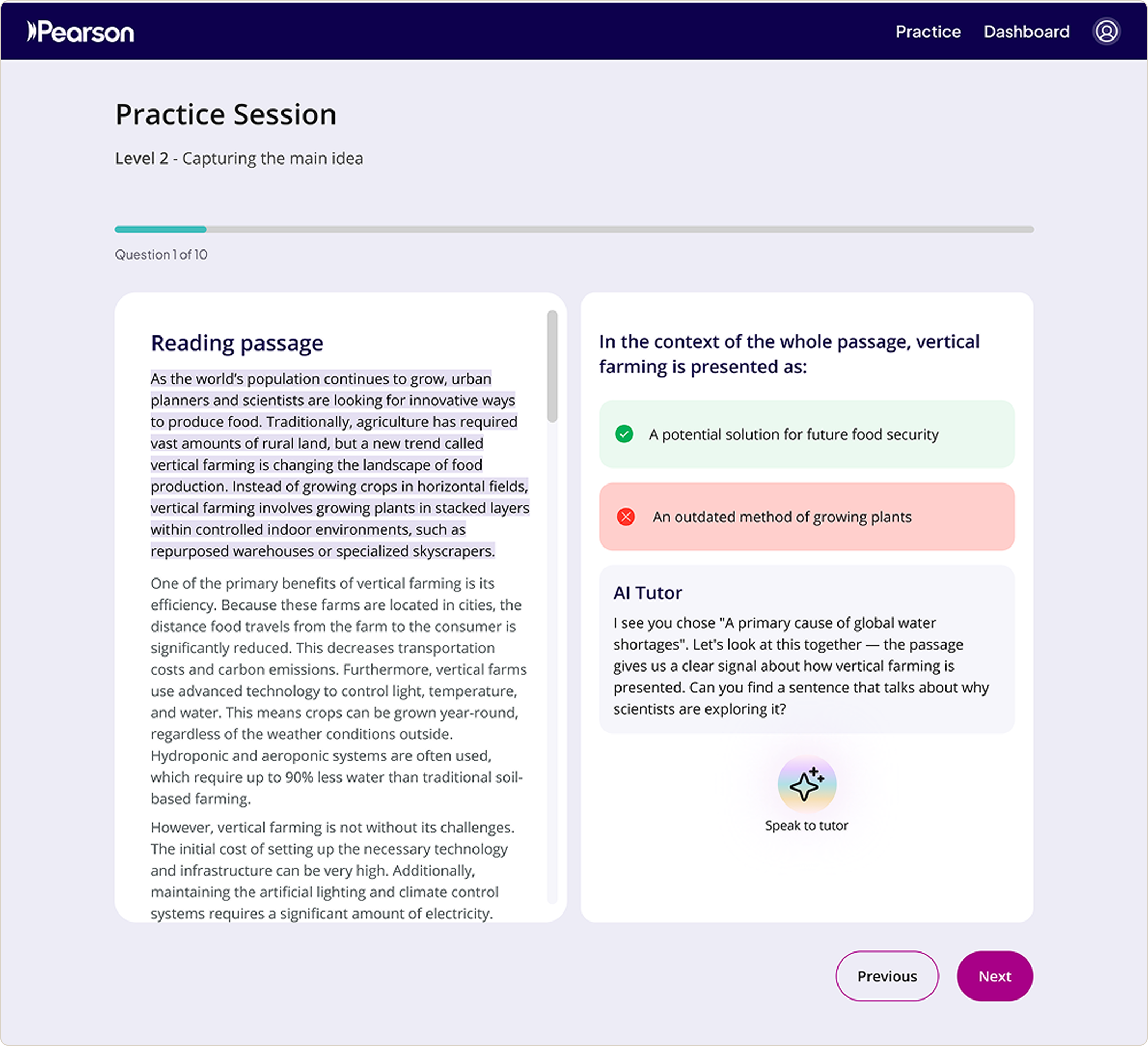
AI tutor: feedback grounded in the passage and nothing else. It reasons only from the text in front of the learner and points to the sentence that settles the question, so an explanation can be verified rather than taken on trust, a deliberate guard against answers that sound convincing but aren’t supported by the text.
User testing
I ran a pilot on UserTesting.com with five PTE learners, framed around desirability and comprehension rather than assessment accuracy. Five findings shaped the next iteration:
AI tutor was the standout
No. 01All five participants named the AI tutor the most useful part of the product.
Explains the why
No. 02Learners valued feedback that pointed to the passage and showed why an answer was wrong, not just that it was.
Discoverability gap
No. 03The tutor wasn’t visible enough, so I moved it into an integrated panel beside the passage.
Scores carry emotion
No. 04A low 25% readiness score deflated beginners, prompting a more encouraging framing.
Metric ambiguity
No. 05The 25% read as either performance or course progress, a dashboard clarity fix.
Iteration: making the tutor impossible to miss
Before: the AI tutor lived behind a floating orb, and all five testers nearly missed it.
After: the tutor now sits in an always-visible panel beside every question.
Final design
The result is a high-fidelity, interactive prototype of an AI reading tutor: a 20-question diagnostic that places the learner on the mastery ladder, adaptive practice targeted at their weakest skills, an integrated AI tutor that explains every mistake against the passage, and three dashboards that tell one story across sessions: where you are, what changed, and what to master next.
A closer look
Outcome and impact
For an Accelerator proof of concept, success was never a launch metric, it was a de-risked decision, and the pilot delivered one. The tutor’s value is validated, its biggest usability risk is already designed out, and Phase 2 metrics are scoped for a 200-participant business case. Next: generative research before build, and a psychometrics partnership to prove the tutor’s feedback is accurate, not just persuasive.
The core bet, validated
The feature the concept rests on was the one every participant singled out.
A shipped iteration
Testing found the tutor was hard to discover, so I redesigned it into an integrated panel, a change driven by a documented finding.
An assessment-UX insight
Scores carry emotional weight; framing a low readiness score for encouragement is a design decision, not a copy tweak.
A business case, scoped
Defined Phase 2 metrics and funnel targets so leadership can decide on a full build against real numbers.